Melt & Pour Soapmaking – Frequently Asked Questions
Can I melt my MP Soap Base on a stove top?
The best way to melt your melt and pour soap is with a double boiler.
Melting soap on direct heat will likely cause the soap to burn.
If you do not have a double boiler, you can use a microwave and a microwave safe glass container. If you chose this method, stir every 30 seconds. Do not allow your soap to boil.
Can I put my MP Soap Base in the freezer?
Yes, you can put it in the freezer for 15-30 minutes. If you completely freeze your soap, you will risk it sweating when it returns to room air. Try to avoid the freezer fan (this causes sweating also). Some soaps with high water content (NOT Crafter’s Choice MP Soaps) will stay cloudy after being in the freezer.
Can I use a crock pot to melt my MP Soap Base?
A crock pot will not work...you will likely burn the soap. A roasting pan will work as long as it has a temperature dial that will go as low as 110º-120º F.
I do not like the way my mp soap turned out...help!
That is okay...you can remelt it!
Is there a natural smell to MP Soap Base?
MP Soap Base should have a slightly sweet smell and frankly, smell like soap. It should not smell rancid or foul.
Is there an easy way to cut up a block of MP Soap Base?
Try a bread dough scraper. You can cut slices and chunks from the block. It is not sharp so you should not cut yourself. Note: Do not use a knife or sharp instrument. Your hands will get slippery from the soap. One slip and you could cut yourself.
My block of Clear MP Soap Base looks cloudy. Is this normal or did I get a bad batch?
This is normal due to the size and thickness of the block. Once you slice off some soap, you will see the true color and clarity.
My bar of MP Soap has white crystals on it...Help! Is this mold?
Unless you added an additive that can mold, it is unlikely these crystals are mold.
The crystals form when your soap dehydrates and dries out. It is most commonly seen during the humid months when the soap sweats and then dehydrates quickly. It will happen if you accidentally boil the soap in the microwave while heating. The best way to prevent this is to wrap the soap as soon as you un-mold it.
My MP Soap has bubbles on the bottom...help!
After you pour the soap, immediately spritz the surface with fine mist of rubbing alcohol. This immediately pops the bubbles. Your soap will not smell like alcohol...the smell quickly disappears. My MP Soap turned brown after two weeks. Why?
You most likely used a fragrance that contains vanilla. I recommend using the Crafter’s Choice Vanilla Color Stabilizer, which will stop the process of vanilla browning in soap.
Some floral and spice type ingredients will turn yellow, orange or brown. There is no product to stop this process. Instead try to work the color change into your design.
What does MP Soap Base mean?
MP Soap Base stands for Melt and Pour Soap Base. This is a special type of soap that has been designed to be melted, crafted and formulated to accept water based additives. When it re-hardens it is ready to use.
Some MP Soap Base formulas are all natural and meets the FDA and public definition of soap.
Some MP Soap Base formulas have additives that enhance the clarity and performance of the soap. The general public considers this product to be soap but the FDA defines this soap as a cosmetic. Both are safe and are popular for different reasons.
What is Glycerin MP Soap Base?
Glycerin Melt and Pour Soap Base a type of Melt and Pour Soap Base. Glycerin is in the soap base either because it is a natural byproduct of the soap making process or it has been incorporated as an additive.
What is the best method for melting soap?
The microwave is the easies, but some may prefer using a double boiler.
Why is my soap sweating?
The official word for this sweating is "Glycerin Dew". Most MP Soap Bases contain glycerin. Glycerin is a humectant which means that it will naturally attract moisture in the air to itself. Humid climates experience the issue the most. Overheating soap in the microwave is the number one cause of glycerin dew because it disrupts the water balance in the soap. Adding too much fragrance or additional oils can be another reason. Can I add palm oil or shea butter to my MP Soap Base?
It is not recommended because the oils will likely go rancid or mold in the soap base. They will also greatly decrease your lather.
You will see soap making recipes that call for oils and butters, such as those you mention, but those recipes are most likely cold or hot process soap recipes.
Does my MP Soap with duck embed need a warning label? Does it need to go through special lead testing?
Yes, you will want to put a warning label on the soap, especially for children under 3 years old. The soap does not need lead testing. This is a requirement of the Consumer Product Safety Commission. Your soap likely falls within the FDA’s jurisdiction.
How much of an additive can I add to my MP Soap Base?
You need to contact your supplier because additives often come in different concentrations. You vendor has the best information on what you have purchased. Do not assume that two products with the same name, have the same concentration. Confirm your information first hand.
My additives are floating in my MP Soap Base...help!
Depending on the additive, floating is a common problem. You can use one of two soap making techniques to over come this dilemma.
Some people add this to make the bar harder. In general they add 3%. Depending on your formula, it may cloud the soap and/or decrease lather. In some all natural bases, it can actually soften the base because it increases the percentage of fatty acids.
Will additives grow mold in MP Soap Base?
Some will and some will not. When in doubt….preserve it! Can I use fabric dye to color soap?
It is highly recommended that you only use FDA approved cosmetic color additives in soap and cosmetics. Soap has an exemption from the FDA color additive rule but that does not mean you can use anything to color your soap. Soap meeting this definition and exemption, falls under the Consumer Product Safety Commission rules. In the event of a problem, the CPSC will likely say that the FDA has established safety guidelines for color additives in skincare products.
Help...my layered soap colors are blending.
The migration or "bleeding" of color is because you used a dye. Dyes are great because they produce bright, stained glass clear color. Dyes are water based. In MP Soap Base dyes will migrate together in layered soap. If you do not want your colors to migrate or "bleed" you will need to use a cosmetic grade pigment, lake color or non migrating mica.
How are Iron Oxides, Pigments, Dyes, Lakes, and Mica Colors different?
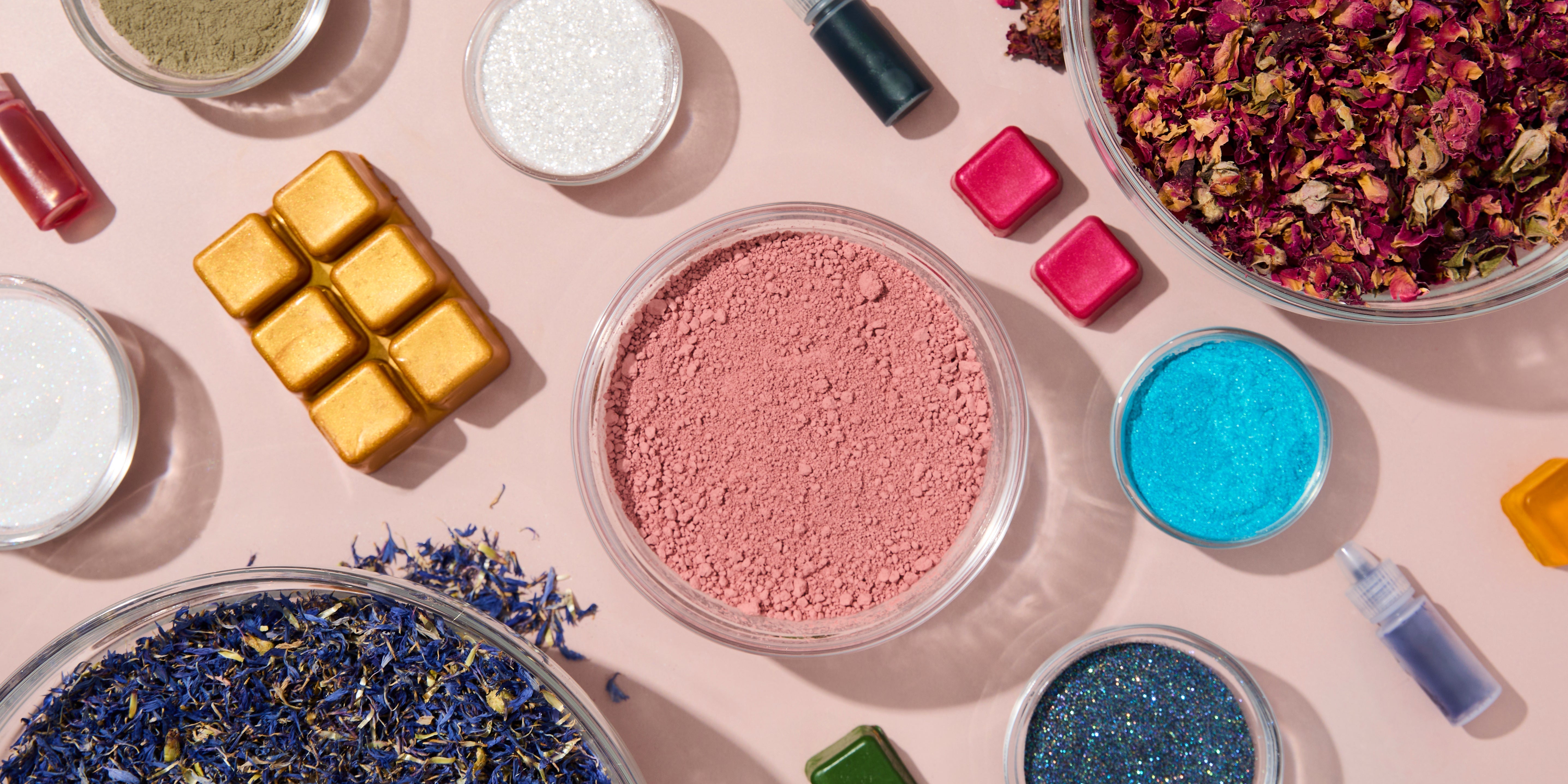
Iron Oxides (sometimes called pigments) are generally considered to be all natural and will not migrate in soap. They tend to be very dull and earth like in color. The red tends to be more of a brick red and the yellow more of a mustard yellow.
Dyes are water based colors. They are bright and vibrant. They look much like stained glass on a church window. They will always migrate in mp soap. They are the only color that allows a clear bar of soap to stay clear.
Lakes are dyes that have been processed with aluminum, barium or calcium. They are bright colors that, when used in moderation, will not migrate in mp soap base.
Mica can sparkle brilliantly. They can also have a soft frosted appearance. Some micas migrate while others do not.
How do I know if I used too much color?
If your soap bubbles are the color of your soap, you have used too much color. Your soap bubbles should always be white.
How do I make a red bar of soap?
A true red bar of soap can only be made with a clear soap base. If you try to make it with white soap, it will turn pink. It is sort of like mixing white paint and red paint…you will always get pink paint. If you would like to make a red bar of mp soap that you cannot see through, color your clear soap red and then add a very small piece of white soap. This will cloud the clear base and your soap will stay red. Are all fragrance oils clear?
No, fragrances can vary greatly in color. They can be dark brown, amber, yellow, orange, green, clear. The color is related to the combined ingredients.
Are EOs safer than FOs?
Not necessarily. Since EOs are all natural and not chemically manipulated, they may not be as stable in some applications. You will also find that if someone has an allergy to a certain plant, the reaction may be exaggerated with the essential oil since it is a concentrated form of the plant material.
Can all fragrances be use
The best way to melt your melt and pour soap is with a double boiler.
Melting soap on direct heat will likely cause the soap to burn.
If you do not have a double boiler, you can use a microwave and a microwave safe glass container. If you chose this method, stir every 30 seconds. Do not allow your soap to boil.
Can I put my MP Soap Base in the freezer?
Yes, you can put it in the freezer for 15-30 minutes. If you completely freeze your soap, you will risk it sweating when it returns to room air. Try to avoid the freezer fan (this causes sweating also). Some soaps with high water content (NOT Crafter’s Choice MP Soaps) will stay cloudy after being in the freezer.
Can I use a crock pot to melt my MP Soap Base?
A crock pot will not work...you will likely burn the soap. A roasting pan will work as long as it has a temperature dial that will go as low as 110º-120º F.
I do not like the way my mp soap turned out...help!
That is okay...you can remelt it!
Is there a natural smell to MP Soap Base?
MP Soap Base should have a slightly sweet smell and frankly, smell like soap. It should not smell rancid or foul.
Is there an easy way to cut up a block of MP Soap Base?
Try a bread dough scraper. You can cut slices and chunks from the block. It is not sharp so you should not cut yourself. Note: Do not use a knife or sharp instrument. Your hands will get slippery from the soap. One slip and you could cut yourself.
My block of Clear MP Soap Base looks cloudy. Is this normal or did I get a bad batch?
This is normal due to the size and thickness of the block. Once you slice off some soap, you will see the true color and clarity.
My bar of MP Soap has white crystals on it...Help! Is this mold?
Unless you added an additive that can mold, it is unlikely these crystals are mold.
The crystals form when your soap dehydrates and dries out. It is most commonly seen during the humid months when the soap sweats and then dehydrates quickly. It will happen if you accidentally boil the soap in the microwave while heating. The best way to prevent this is to wrap the soap as soon as you un-mold it.
My MP Soap has bubbles on the bottom...help!
After you pour the soap, immediately spritz the surface with fine mist of rubbing alcohol. This immediately pops the bubbles. Your soap will not smell like alcohol...the smell quickly disappears. My MP Soap turned brown after two weeks. Why?
You most likely used a fragrance that contains vanilla. I recommend using the Crafter’s Choice Vanilla Color Stabilizer, which will stop the process of vanilla browning in soap.
Some floral and spice type ingredients will turn yellow, orange or brown. There is no product to stop this process. Instead try to work the color change into your design.
What does MP Soap Base mean?
MP Soap Base stands for Melt and Pour Soap Base. This is a special type of soap that has been designed to be melted, crafted and formulated to accept water based additives. When it re-hardens it is ready to use.
Some MP Soap Base formulas are all natural and meets the FDA and public definition of soap.
Some MP Soap Base formulas have additives that enhance the clarity and performance of the soap. The general public considers this product to be soap but the FDA defines this soap as a cosmetic. Both are safe and are popular for different reasons.
What is Glycerin MP Soap Base?
Glycerin Melt and Pour Soap Base a type of Melt and Pour Soap Base. Glycerin is in the soap base either because it is a natural byproduct of the soap making process or it has been incorporated as an additive.
What is the best method for melting soap?
The microwave is the easies, but some may prefer using a double boiler.
Why is my soap sweating?
The official word for this sweating is "Glycerin Dew". Most MP Soap Bases contain glycerin. Glycerin is a humectant which means that it will naturally attract moisture in the air to itself. Humid climates experience the issue the most. Overheating soap in the microwave is the number one cause of glycerin dew because it disrupts the water balance in the soap. Adding too much fragrance or additional oils can be another reason. Can I add palm oil or shea butter to my MP Soap Base?
It is not recommended because the oils will likely go rancid or mold in the soap base. They will also greatly decrease your lather.
You will see soap making recipes that call for oils and butters, such as those you mention, but those recipes are most likely cold or hot process soap recipes.
Does my MP Soap with duck embed need a warning label? Does it need to go through special lead testing?
Yes, you will want to put a warning label on the soap, especially for children under 3 years old. The soap does not need lead testing. This is a requirement of the Consumer Product Safety Commission. Your soap likely falls within the FDA’s jurisdiction.
How much of an additive can I add to my MP Soap Base?
You need to contact your supplier because additives often come in different concentrations. You vendor has the best information on what you have purchased. Do not assume that two products with the same name, have the same concentration. Confirm your information first hand.
My additives are floating in my MP Soap Base...help!
Depending on the additive, floating is a common problem. You can use one of two soap making techniques to over come this dilemma.
- Melt the soap, add color, fragrance and additives. Leave soap in mixing container and cover with plastic wrap. Once the soap reaches 115ºF. Stir once and pour into the mold. The soap will re-harden quickly, not allowing additives to float.
Some people add this to make the bar harder. In general they add 3%. Depending on your formula, it may cloud the soap and/or decrease lather. In some all natural bases, it can actually soften the base because it increases the percentage of fatty acids.
Will additives grow mold in MP Soap Base?
Some will and some will not. When in doubt….preserve it! Can I use fabric dye to color soap?
It is highly recommended that you only use FDA approved cosmetic color additives in soap and cosmetics. Soap has an exemption from the FDA color additive rule but that does not mean you can use anything to color your soap. Soap meeting this definition and exemption, falls under the Consumer Product Safety Commission rules. In the event of a problem, the CPSC will likely say that the FDA has established safety guidelines for color additives in skincare products.
Help...my layered soap colors are blending.
The migration or "bleeding" of color is because you used a dye. Dyes are great because they produce bright, stained glass clear color. Dyes are water based. In MP Soap Base dyes will migrate together in layered soap. If you do not want your colors to migrate or "bleed" you will need to use a cosmetic grade pigment, lake color or non migrating mica.
How are Iron Oxides, Pigments, Dyes, Lakes, and Mica Colors different?
Iron Oxides (sometimes called pigments) are generally considered to be all natural and will not migrate in soap. They tend to be very dull and earth like in color. The red tends to be more of a brick red and the yellow more of a mustard yellow.
Dyes are water based colors. They are bright and vibrant. They look much like stained glass on a church window. They will always migrate in mp soap. They are the only color that allows a clear bar of soap to stay clear.
Lakes are dyes that have been processed with aluminum, barium or calcium. They are bright colors that, when used in moderation, will not migrate in mp soap base.
Mica can sparkle brilliantly. They can also have a soft frosted appearance. Some micas migrate while others do not.
How do I know if I used too much color?
If your soap bubbles are the color of your soap, you have used too much color. Your soap bubbles should always be white.
How do I make a red bar of soap?
A true red bar of soap can only be made with a clear soap base. If you try to make it with white soap, it will turn pink. It is sort of like mixing white paint and red paint…you will always get pink paint. If you would like to make a red bar of mp soap that you cannot see through, color your clear soap red and then add a very small piece of white soap. This will cloud the clear base and your soap will stay red. Are all fragrance oils clear?
No, fragrances can vary greatly in color. They can be dark brown, amber, yellow, orange, green, clear. The color is related to the combined ingredients.
Are EOs safer than FOs?
Not necessarily. Since EOs are all natural and not chemically manipulated, they may not be as stable in some applications. You will also find that if someone has an allergy to a certain plant, the reaction may be exaggerated with the essential oil since it is a concentrated form of the plant material.
Can all fragrances be use