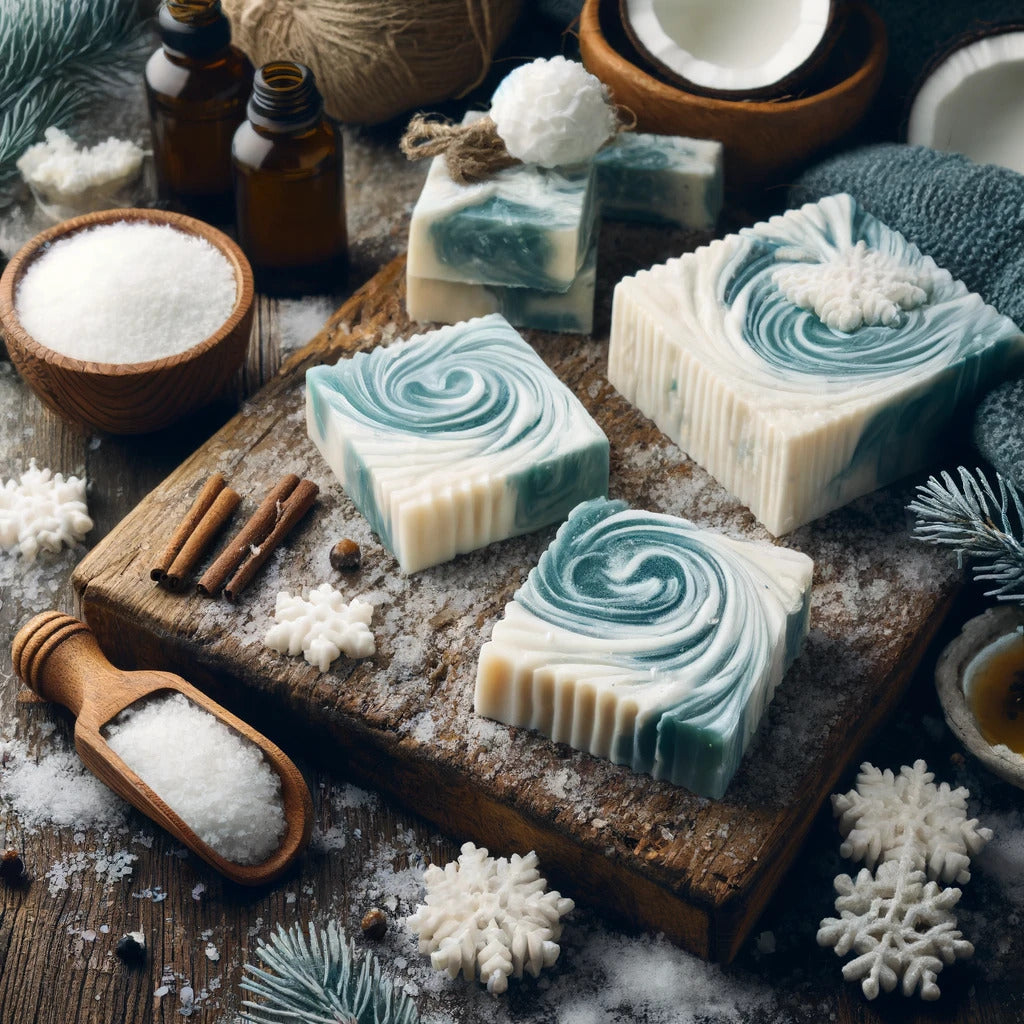
Snowdrift Swirl Soap Recipe
Creating your own Snowdrift Swirl soap is not only a rewarding DIY project but also a delightful way to bring the mesmerizing beauty of swirling snow into your bathroom. This black and white soap boasts an artistic contrast that captures the essence of a snowy winter day with elegance and style. Below the recipe you’ll find some tips and additional insights to help you perfect your soap-making technique and make the most out of this snowy adventure. INFORMATION
Before starting this tutorial please make sure to read all instructions.
You should have a basic understanding of making cold-process soap before you begin this tutorial.
It is always a good practice to put any new recipe through a soap calculator like the one found at http://soapcalc.net/calc/SoapCalcWP.asp.
Step 1 – Measure All Ingredients
Now put on your long sleeves, long pants, shoes, safety goggles, and gloves. Work in a well ventilated area that is free from distractions.
To make the process go faster, measure all ingredients first. To cut down on dishes, measure cold water into the funnel pitcher, measure coconut oil into the large mixing bowl, and measure the essential oils into the same container. Measure sodium hydroxide last.
Step 2 – Make Lye Solution
Sprinkle approximately half of the sodium hydroxide into the water, stir gently to avoid splashing. Make sure to avoid breathing any fumes. Repeat, and stir until mixture is dissolved. (Always add lye to water and not the other way around because of the potential lye volcano. Just remember, “Snow falls on the lake.”) Cover with plastic wrap and set aside in a safe place to cool.
Step 3 – Make Oil Solution
Melt coconut oil in 30 second bursts until completely melted. Next, add shea butter and break up big pieces with a spoon and stir until melted. If needed microwave in short bursts. Avoid getting the mixture above 117°F.
Now add the olive oil, melted palm oil, castor oil and avocado oil to the coconut oil and shea butter.
Step 4 – Add Clay to Essential Oils
Add kaolin clay to your peppermint and tea tree essential oils. Mix, then, add to your batch oils and set aside to cool.
Step 5 – Prepare Colorants
For a Black Swirl:
Add 0.5 tsp smooth coconut carbon powder to a zipper bag and add .5 Tbsp olive oil.
For a Red Swirl:
0.15 cc scoops Red Oxide and a heaping 1/8 tsp Molten Lava Pigment to a zipper bag and add 2 tsp olive oil.
For Both Colors:
Next, add 1.5 tsp titanium dioxide to the other zipper bag. Then, add 1.5 Tbsp olive oil. Then, mix both of these bags until no clumps remain.
(This can be done ahead of time. Be patient as the titanium dioxide takes a bit of time to incorporate. If you don’t completely incorporate it, you will see smears of white in your cut soap.) (I don’t use water to introduce titanium dioxide to my soap because it needs to be stick blended into the oils to mix well. I don’t like stick blending at this point because it can cause the batter to become too thick to swirl. Using titanium dioxide mixed with oil can be stirred in by hand and incorporates nicely.)
Use your hands and a paper towel to smear colorants until smooth.
Step 6 – Make Soap
If you are forcing your soap through gel, now would be a good time to preheat the heating pad.*
When the temperatures of the lye solution and the oil solution are within 85° —95° F, carefully (with safety gear still on) strain the lye solution into the other funnel pitcher and add the sodium lactate. Use paper towels to wipe the strainer and empty the pitcher, then dispose of the paper towels.
Add the lye solution to the oil solution. Pour ingredients down the side of the bowl or down a spatula to avoid adding air bubbles to the mixture.
Stick blend until an emulsion is reached when oils are no longer separated from the lye solution.
Pour 1/8th or 6 oz. of the batter into a funnel pitcher. Add and mix in all of the premixed coconut carbon. If using titanium dioxide, add that to the remaining batter. Stir to incorporate.
Step 7 – Pour Soap
When your batter is at light trace, it is ready to pour. You can tell your batter is at light trace when it starts to stick to the side of the bowl and stick blender instead of just running off. For this swirl, the thinner your batter is, the thinner and wispier the design will be.
The diagram below shows how to pour and swirl the soap. The top drawing shows the pour. The other two drawings show how to swirl the batter.
First pour around one third of the white batter.
Then, carefully pour all of the black batter on top. Pour close to the surface to avoid breaking through the white batter. (Don’t scrap out all the batter if you want to save a bit for the top design.)
Next, pour remaining white batter, first on the sides and then on top of the black batter.
Step 8 – Swirl Soap
When you insert the swirl tool for the first time, insert it all the way to the bottom. (The batter on the tool will be a reference to how far it is to the bottom.) Now, drag your swirl tool through the batter, up and down, as shown in the middle drawing above. Using the batter on the tool for reference, try not to touch the bottom.
For the last swirl, follow the path shown in the bottom drawing.
Step 9 – Design Soap Top
Splatter remaining batter on top of poured soap in a random pattern.
Then, slightly insert a skewer and drag it back and forth to make the pattern below.
Next, slightly insert the skewer in the left end and drag to the right and repeat many times to make the pattern below.
Step 10 – Put Through Gel*
Next, set your mold on top of the heating pad. Then, cover with a box. Next, insulate with blankets/towels. Set your timer for 20 minutes. When the timer rings, slide your hand up under the box and feel the air. If the air is warm, turn off the heating pad. If it’s not warm, keep repeating in 20 minute increments until the air in the
- Difficulty: Intermediate
- Yield: 10 Bars
- Prep Time / Clean Up: 15 Minutes
- Perform Time: 1 Hour, 30 Minutes
- Total Time: 1 Hour, 45 Minutes (longer if putting through gel, which is recommended)
- Cure Time: 4-6 Weeks
- Goggles
- Extra Long Disposable Nitrile Gloves (easily found in the dishwashing section at the local supermarket)
- Digital Scale
- Digital Thermometer or Infrared Thermometer
- Stick Blender
- Mini Cordless Mixer
- 2 Quart Glass Mixing Bowl or Microwavable Plastic Bowl
- 2 x Funnel Pitchers
- Small Containers (for holding ingredients)
- 2 x One Quart Zipper Freezer Bags (for mixing Colorants)
- Spatula
- 2 x Pipettes (for Essential Oils)
- Measuring Spoons
- Fine Mesh Strainer (Stainless Steel)
- Paper Towels
- Plastic Wrap
- 10” Silicone Loaf Mold
- Hanger Swirl Tool
- Heating Pad (Optional)
- Timer (Optional)
- Cardboard Box That Fits over Mold (Optional)
- Towels/Blankets (Optional)
- Vegetable Peeler (Optional)
- 11.6 oz Olive Oil (35%) + around 1.5 oz for mixing colorants
- 9.9 oz Coconut Oil (30%)
- 6.6 oz Palm Oil (melted) (20%)
- 3.3 oz Shea Butter (10%)
- 1.0 oz Castor Oil (3%)
- 0.7 oz Avocado Oil (2%)
- 2 tsp White Kaolin Clay (1t PPO)
- 0.7 oz Peppermint Essential Oil (Medium Strength)
- 0.7 oz Tea Tree Essential Oil (Medium Strength)
- 1.5 tsp Titanium Dioxide (Optional)
- 8.3 oz Cold Distilled Water (25% Water as a percent of oil weight)
- 2 tsp Sodium Lactate 60% (Optional) (helps soap to harden and release from mold sooner) (1 teaspoon per pound of oils) If not available, dissolve 1/4 teaspoon salt per pound of hard (saturated) oils in distilled water. For this recipe use a scant 1/4 teaspoon.)
- 4.7 oz Sodium Hydroxide (Lye) (6% Super Fat/Lye discount)
- For Black Swirl “Snowdrift Swirl Soap”: 0.5 tsp Smooth Coconut Carbon Powder
- For Red Swirl “Peppermint Swirl Soap”: 0.15 cc Scoops Red Oxide and 1 heaping 1/8 tsp Molten Lava Neon Pigment
Before starting this tutorial please make sure to read all instructions.
You should have a basic understanding of making cold-process soap before you begin this tutorial.
It is always a good practice to put any new recipe through a soap calculator like the one found at http://soapcalc.net/calc/SoapCalcWP.asp.
Step 1 – Measure All Ingredients
Now put on your long sleeves, long pants, shoes, safety goggles, and gloves. Work in a well ventilated area that is free from distractions.
To make the process go faster, measure all ingredients first. To cut down on dishes, measure cold water into the funnel pitcher, measure coconut oil into the large mixing bowl, and measure the essential oils into the same container. Measure sodium hydroxide last.
Step 2 – Make Lye Solution
Sprinkle approximately half of the sodium hydroxide into the water, stir gently to avoid splashing. Make sure to avoid breathing any fumes. Repeat, and stir until mixture is dissolved. (Always add lye to water and not the other way around because of the potential lye volcano. Just remember, “Snow falls on the lake.”) Cover with plastic wrap and set aside in a safe place to cool.
Step 3 – Make Oil Solution
Melt coconut oil in 30 second bursts until completely melted. Next, add shea butter and break up big pieces with a spoon and stir until melted. If needed microwave in short bursts. Avoid getting the mixture above 117°F.
Now add the olive oil, melted palm oil, castor oil and avocado oil to the coconut oil and shea butter.
Step 4 – Add Clay to Essential Oils
Add kaolin clay to your peppermint and tea tree essential oils. Mix, then, add to your batch oils and set aside to cool.
Step 5 – Prepare Colorants
For a Black Swirl:
Add 0.5 tsp smooth coconut carbon powder to a zipper bag and add .5 Tbsp olive oil.
For a Red Swirl:
0.15 cc scoops Red Oxide and a heaping 1/8 tsp Molten Lava Pigment to a zipper bag and add 2 tsp olive oil.
For Both Colors:
Next, add 1.5 tsp titanium dioxide to the other zipper bag. Then, add 1.5 Tbsp olive oil. Then, mix both of these bags until no clumps remain.
(This can be done ahead of time. Be patient as the titanium dioxide takes a bit of time to incorporate. If you don’t completely incorporate it, you will see smears of white in your cut soap.) (I don’t use water to introduce titanium dioxide to my soap because it needs to be stick blended into the oils to mix well. I don’t like stick blending at this point because it can cause the batter to become too thick to swirl. Using titanium dioxide mixed with oil can be stirred in by hand and incorporates nicely.)
Use your hands and a paper towel to smear colorants until smooth.
Step 6 – Make Soap
If you are forcing your soap through gel, now would be a good time to preheat the heating pad.*
When the temperatures of the lye solution and the oil solution are within 85° —95° F, carefully (with safety gear still on) strain the lye solution into the other funnel pitcher and add the sodium lactate. Use paper towels to wipe the strainer and empty the pitcher, then dispose of the paper towels.
Add the lye solution to the oil solution. Pour ingredients down the side of the bowl or down a spatula to avoid adding air bubbles to the mixture.
Stick blend until an emulsion is reached when oils are no longer separated from the lye solution.
Pour 1/8th or 6 oz. of the batter into a funnel pitcher. Add and mix in all of the premixed coconut carbon. If using titanium dioxide, add that to the remaining batter. Stir to incorporate.
Step 7 – Pour Soap
When your batter is at light trace, it is ready to pour. You can tell your batter is at light trace when it starts to stick to the side of the bowl and stick blender instead of just running off. For this swirl, the thinner your batter is, the thinner and wispier the design will be.
The diagram below shows how to pour and swirl the soap. The top drawing shows the pour. The other two drawings show how to swirl the batter.
First pour around one third of the white batter.
Then, carefully pour all of the black batter on top. Pour close to the surface to avoid breaking through the white batter. (Don’t scrap out all the batter if you want to save a bit for the top design.)
Next, pour remaining white batter, first on the sides and then on top of the black batter.
Step 8 – Swirl Soap
When you insert the swirl tool for the first time, insert it all the way to the bottom. (The batter on the tool will be a reference to how far it is to the bottom.) Now, drag your swirl tool through the batter, up and down, as shown in the middle drawing above. Using the batter on the tool for reference, try not to touch the bottom.
For the last swirl, follow the path shown in the bottom drawing.
Step 9 – Design Soap Top
Splatter remaining batter on top of poured soap in a random pattern.
Then, slightly insert a skewer and drag it back and forth to make the pattern below.
Next, slightly insert the skewer in the left end and drag to the right and repeat many times to make the pattern below.
Step 10 – Put Through Gel*
Next, set your mold on top of the heating pad. Then, cover with a box. Next, insulate with blankets/towels. Set your timer for 20 minutes. When the timer rings, slide your hand up under the box and feel the air. If the air is warm, turn off the heating pad. If it’s not warm, keep repeating in 20 minute increments until the air in the